21 July, 2026
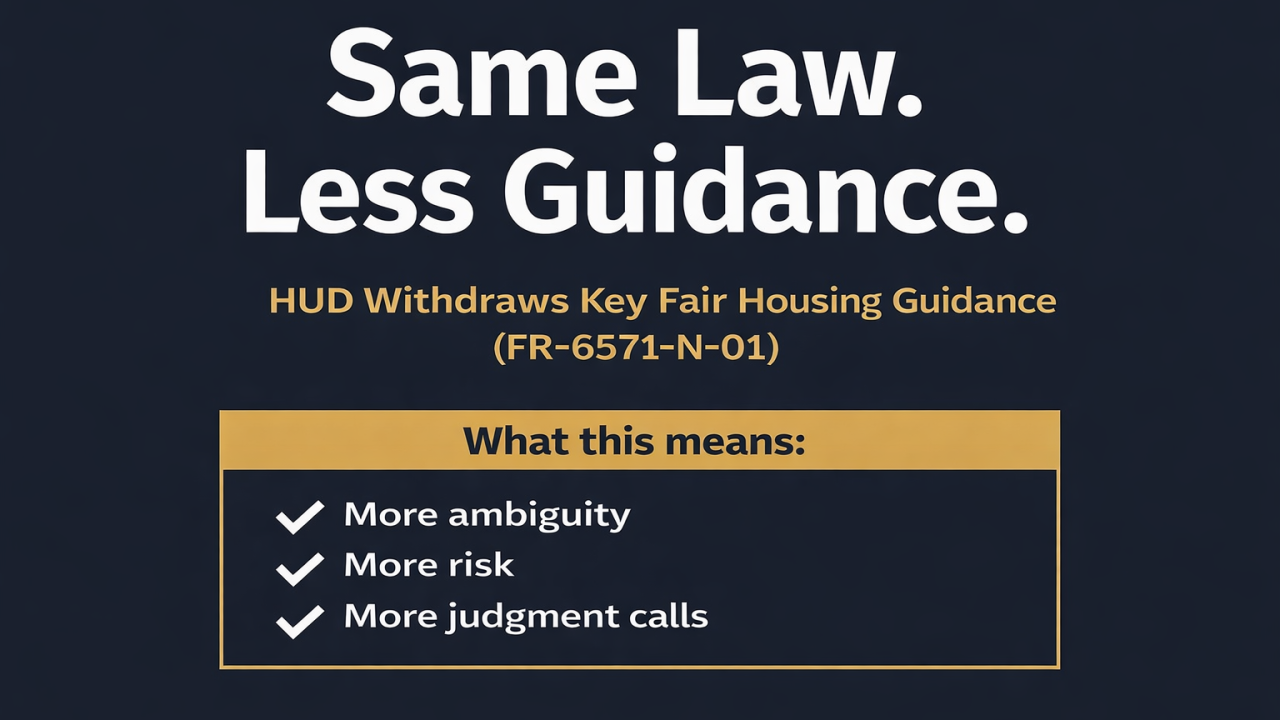
The Law Remains. The Guidance Keeps Disappearing.
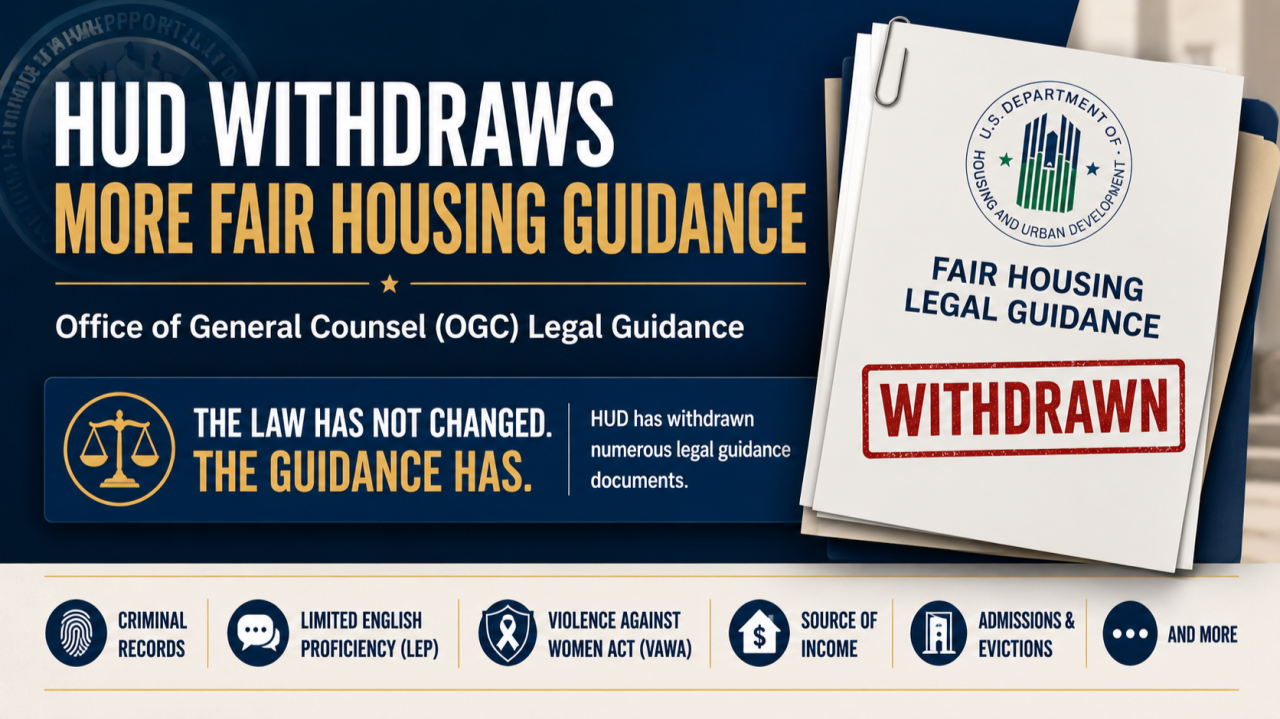
HUD has withdrawn another group of Fair Housing legal guidance documents—this time from its Office of General Counsel.
Just three months after withdrawing numerous Fair Housing and Equal Opportunity (FHEO) guidance documents, HUD has issued another withdrawal notice. FR-2026-07-17
This time, however, the guidance being withdrawn comes from HUD’s Office of General Counsel (OGC)—the attorneys responsible for interpreting and enforcing federal housing laws.
The significance of this action shouldn’t be underestimated.
Among the documents withdrawn are legal guidance concerning:
- criminal records
- limited English proficiency (LEP)
- land use and zoning
- gender identity and sexual orientation following Bostock
- Violence Against Women Act (VAWA)
- source of income restrictions
- admissions and evictions in federally assisted housing
- special purpose credit programs
- the Mrs. Murphy exemption
- fair housing “elements of proof” used in enforcement actions
What Hasn’t Changed
The Fair Housing Act has not changed.
Neither have the underlying statutes protecting applicants and residents.
Housing providers remain responsible for complying with federal law.
What Has Changed
HUD has withdrawn many of the legal interpretations that compliance professionals relied upon when making difficult decisions.
The Department states that these guidance documents:
- have been removed from active use;
- should not be relied upon as authoritative; and
- may be replaced with new guidance where appropriate.
That creates uncertainty.
Why This Matters
For most site managers, compliance isn’t difficult because the law is clear.
It’s difficult because real-life situations rarely fit neatly into statutory language.
Questions such as:
- May we consider an applicant’s criminal history?
- What accommodations are required for applicants with limited English proficiency?
- When does a local zoning decision become a Fair Housing issue?
- How should admissions and eviction policies be applied?
These are exactly the kinds of questions HUD’s guidance attempted to answer.
Without those interpretations, housing providers are left relying primarily on statutes, regulations, case law, and their own legal counsel.
My Take
As someone who has spent more than four decades training housing professionals, I have always viewed HUD guidance as exactly what its name suggests—guidance, not law.
But good guidance served an important purpose.
It promoted consistency.
It helped Owners and Agents understand HUD’s thinking before making operational decisions.
Removing that guidance does not remove the need to make those decisions.
It simply means we must make them with fewer signposts.
The law remains.
The questions remain.
Only many of the answers HUD previously provided have been withdrawn.